
What Does It Cost to Build a Casita? A Guide to Pricing for Prefab Casitas
New Frameworks is a worker-owned cooperative based in Essex Junction, Vermont, specializing in prefabricated straw bale panel building systems for residential construction. Our Casita Kits are designed for use as primary homes, accessory dwelling units (ADUs), and in-law suites — offering high-performance, low embodied-carbon, healthy construction at a price point accessible to a wider range of builders and homeowners.
This guide breaks down the real cost of building a New Frameworks Casita from the ground up — including site work, contractor selection, and material finish choices — and explains how our prefabricated straw bale panel system can shorten construction timelines, reduce on-site labor costs, and make high-performance natural building achievable for owner-builders and smaller crews.
High-performance natural building in the Northeast typically runs $450–$700 per square foot for units under 1,000 SF. This guide is designed to help you understand what drives that number — and how to work within it.
NOTE: The cost ranges in this guide are based on historical project averages from our work in the Northeast, where New Frameworks has been building for the past 20 years. If you're building outside the Northeast, your numbers may vary from the ones listed here (i.e. Midwest or Middle-America might have lower costs, and the West Coast may have comprable or higher costs). To get a better sense of costs specific to your location, schedule a discovery call with our team — a link is included in the automated email you'll receive after filling out a Casita Inquiry Form.
The Bigger Context: What Does High-Performance Building Cost?
Before we break down the numbers, it helps to know where straw panel construction sits in the broader market. High-performance, durable, healthy building in the Northeast — the kind that delivers low-carbon, healthy, energy-efficient homes with mid-range, non-toxic, natural finishes — typically runs $450 to $700 per square foot for units under 1000 SF, and between $400-$600/SF for units over 1000 SF.
One thing that surprises a lot of first-time builders: the smaller the unit, the higher the cost per square foot. This is because the most expensive parts of any home are the kitchen and bathroom. Those costs don't scale down the way square footage does — a bathroom in a 400 SF home costs roughly the same as a bathroom in a 1,200 SF home, so it represents a much larger share of the total budget in a smaller unit. Keep this in mind when you're comparing per-square-foot numbers across different project sizes.
Our Casita Kits — prefabricated straw panel systems that include everything needed to achieve a high-performance, weatherized shell — are priced by region and manufacturing partner. Pricing is reviewed and updated quarterly, and all Seed Collaborative participants are eligible to produce Casitas, so we can place you with a manufacturer that is as local as possible.
To get current pricing and kit inclusions, fill out our Casita inquiry form. You'll receive an automated email with pricing details, followed by a direct follow-up from our team with shipping information specific to your location, and the opportunity to schedule a video discovery call.
We’ll continue to outline the advantages of using prefabricated straw panels in construction, and costs beyond what’s included in each Casita kit, below.
Why Straw Panels Change the Equation
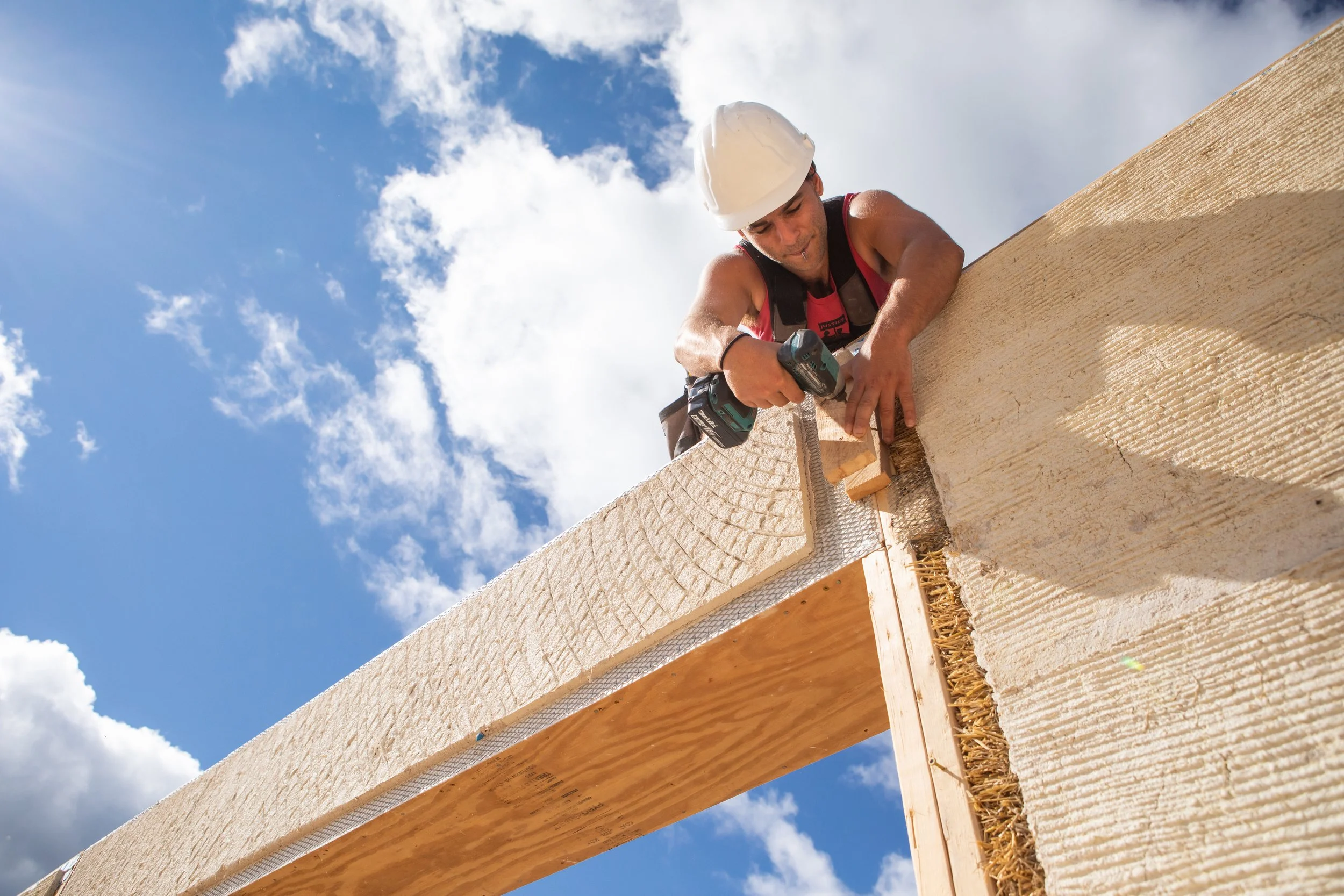
Building with New Frameworks straw panels — and with members of the Seed Collaborative working within the same panel system — is cost-comparable to site-building an equivalent high-performance wall assembly using conventional methods. We're talking about a wall system that delivers R-38 to R-60 insulation, is air-sealed, vapor-open, thermally-broken, and airtight: the full package you'd expect from a premium enclosure.
The difference is in how you get there.
A conventional wall assembly at this performance level requires heavily sequenced, skilled labor on site — framers, insulators, air sealing specialists — all carefully coordinated, all dependent on each other. That sequencing takes time, and time on a job site is money.
Our panel system removes an entire chapter of that process. Framing, insulation, sheathing, interior air barrier, and exterior weather-resistant barrier are all fabricated off site in our facility — and because that work happens in parallel with your site work rather than after it, you're not waiting for one phase to finish before the next can begin. Typically, site work has to be complete before framing can start on site. With prefabricated panels, those timelines run simultaneously, shortening your overall construction schedule by many weeks or months.
When the panels arrive, they're ready to perform. Small teams, less experienced crews, and even owner-builders can install them — that accessibility was designed in from the start. The panels can be assembled in as little as 1-4 weeks depending on the size of the unit.
That compressed timeline translates directly into savings — typically 2–5% of total project costs — on everything that runs by the day: on-site labor, equipment rental, temporary utilities, site facilities, and general contractor overhead. But it's not just construction costs. Every week you shave off the schedule is a week you're not simultaneously paying rent and a construction loan. And a tighter timeline means less exposure to the delays that have a way of compounding — and getting expensive.
The Three Things That Determine Your Total Cost
No matter the project, total cost comes down to three things:
1. Site work 2. Your contractor 3. Your material finish selections
Each of these can vary enormously, and they're largely independent of each other. An already-developed site with an experienced contractor and simple finishes is a very different project from a raw parcel with complex utility installation and a high-end kitchen. We'll break all three down below.
1. Site Work
Site work covers everything that has to happen before your Casita goes up: establishing access, grading, foundation, utilities, permits, and any clearing or prep the land requires. It's often the biggest variable in the budget, and it's the one most people underestimate.
The single biggest factor is whether your land is improved or unimproved. The estimates below are based on Vermont, but the cost categories apply broadly across the US — if you're outside the Northeast, the ranges may look different, but the line items are worth knowing regardless.
Improved land — a property that already has utilities (water, electricity, sewage) in place, like a backyard where you're adding an ADU — typically runs $25,000 to $50,000 in site work costs in Vermont.
Unimproved land — a raw parcel without existing infrastructure — requires more: clearing, access roads, utility installation from scratch. Site work on unimproved land in Vermont commonly runs $50,000 to $150,000.
Here's a general breakdown of what you might encounter:
Site evaluation: $500 to $2,000. This assesses your site for suitability and flags any challenges. If you purchase a Casita Kit with General Contracting Support from New Frameworks or one of our Seed Collaborative partners, this is included in your package.
Site preparation and grading: $1,000 to $5,000 or more, depending on conditions. With our preferred helical pier foundation, this cost is often minimized or eliminated entirely.
Foundation (helical piers): $6,000 to $18,000 depending on unit size. Helical piers are our preferred foundation method — they're fast, they minimize site disturbance, and they work well on a range of soil conditions.
Utility connections: $2,000 to $10,000, depending on how close existing connections are.
Electrical service (unimproved land): $7,000 to $10,000, depending on distance from the nearest utility pole.
Wastewater/septic: Highly variable. If you're connecting to an existing septic system, you'll need to confirm it can handle the additional load. A new system or expanded capacity can vary significantly by location and local regulations — get a local quote early. Also, check state and local regulations to see if a state wastewater permit is required.
Sprinkler system: $13,000 to $15,000 if required. In Vermont, very few jurisdictions currently require this depending on how the unit is sited, but it's worth checking with your local code authority.
A note on DIY and trade connections: All of these numbers assume you're hiring everything out. If you have experience in any of these areas, friends in the trades, or are willing to take on parts of the work yourself, costs can come down considerably. Site work is one of the areas where owner-involvement or informal trade relationships can make the biggest dent in the budget.
New Frameworks, and many of our Seed Collaborative partners, also offer a Sitework Management Service for Casita Kit purchasers, which covers permitting, trenching, foundation installation, utility coordination, and site restoration after construction. If you'd rather have one team managing the process end to end, this is worth asking about.
2. Your Contractor
Labor is the second major variable. General contractor rates, subcontractor availability, and regional market conditions all shift this number significantly — and it changes year to year. Most general contractors will offer two approaches to estimating, and which makes sense for you depends on your budget flexibility and the complexity of your project.
1. Cost per Square Foot Pricing
This is a ballpark method based on a contractor's historical experience. If they've built several homes of similar size and finish level, they'll use those past projects to establish a $/SF range that reflects their typical labor, materials, and markup — generally 15–30% on materials and subcontractors, and around 100% on labor, though this varies by contractor, state, and trade.
A higher $/SF range usually signals a higher-end contractor working with more refined materials. A mid-market contractor will typically land in a lower range. Either way, what that number is really telling you is the cost of their labor and markup applied to a historically consistent material spec.
One thing worth flagging: $/SF pricing doesn't scale linearly, and it's worth asking your contractor whether they're working from total building footprint or livable square footage — because those are often different numbers, and homes are typically marketed by livable SF, not total footprint.
2. Preconstruction Design and Estimating
This is a line-item approach that gets into the specifics of your actual project — every finish, every fixture, every knob and handle. It's significantly more precise, but it takes time and typically costs $5,000–$20,000 in contractor hours just to arrive at a total budget number.
In practice, most contractors will start with a general $/SF range to confirm the project is roughly in scope, then move into detailed estimating based on your actual design decisions and material selections. If you have a tight budget or a highly customized design, this method gives you much better cost certainty before you break ground.
If you're looking to reduce costs by handling some of the work yourself, there are a few areas where homeowners can reasonably take the reins — particularly if they're comfortable coordinating trades and willing to seek input from professionals where they lack prior experience.
Site work is one of the most accessible areas for homeowner involvement. Upgrading or installing electrical service, connecting to an existing septic or wastewater system, drilling a new well, connecting to existing water supply — these are all tasks that homeowners can often schedule and coordinate directly with the relevant trade contractors, without routing that work through a general contractor. Since GCs typically mark up subcontractor costs, cutting out that layer on site utilities can represent significant savings. The main thing to get right is sequencing — most of these items need to be in place before the foundation goes in, so knowing when to schedule each trade is critical.
The other opportunity is direct labor — taking on installation, finishing work, or acting as your own GC on some or all of the project.
To help you figure out where the savings opportunities are, here's how costs typically break down on New Frameworks general contracting projects:
50% labor
30% materials
20% subcontractors and equipment rental
This is a useful map if you're thinking about where owner-involvement could move the needle. Labor is the largest slice, which means any work you can credibly take on yourself — site prep, installation, finishing — has the biggest potential impact on your bottom line.
One important note for homeowner-GCs purchasing a prefabricated kit: panel fabrication is already split between our labor and materials costs on the production side, so by the time the kit arrives on your site, you're not starting from the same 50/30/20 baseline. For a kit-based project where you're managing installation yourself, a more realistic breakdown looks closer to 40% materials, 40% labor, and 20% subcontractors and equipment rental. The materials share goes up because you're buying a finished product; the labor share reflects what's left to do on your site.
What we can say is that because our panel system is designed for accessibility, you have more options here than you would with a conventional high-performance build. Smaller and less specialized crews can do the work — you don't need a team with deep experience in advanced enclosure systems. That opens up the contractor pool and keeps competitive pricing realistic.
If you're an owner-builder or working with a homeowner-GC arrangement, this is one of the areas where the New Frameworks straw panel system was specifically designed to support you.
3. Material Finish Selections
Finish costs — cabinets, fixtures, flooring, lighting, hardware, tile — are entirely in your control, and they can move the needle more than most people expect. The difference between a modest and a premium finish package in a small unit can easily be $30,000–$50,000 or more, so if you're looking to manage costs, this is one of the most effective places to do it.
It's also where personal priorities tend to diverge the most. Some people put their budget into the kitchen and keep everything else simple. Others prioritize flooring or custom millwork. There's no right answer — but these decisions are worth making deliberately, before they start accumulating.
To help with early-stage estimating, New Frameworks offers two document sets:
Pricing Set: Includes the panel installation sequence and square footage takeoffs, giving general contractors what they need to estimate total material finish costs.
Architectural Set: The full document package used to estimate complete unit construction, in significantly more detail.
Both sets are included with a kit purchase, but can also be purchased separately beforehand — which is worth considering if you want more time to work through estimates with your contractor before committing to the kit.
Upon request, New Frameworks can also share materials schedules from past units. These are typically customized to each client's preferences, so they won't map exactly to our standard models — but if you've seen our Casitas online, particularly with our 3D tours of finished Casitas (Terra 600, Árbol 1200) and want to replicate that look and feel, they're a useful starting point.
The Power is in Your Hands
Site work, contractor choice, and finish selections are the three levers that move the budget most — and all three are largely in your hands. A parallel construction timeline means fewer weeks paying rent and a construction loan at the same time. An accessible panel system means a wider contractor pool and more room for owner-involvement. Intentional finish decisions mean the difference between a project that strains your budget and one that doesn't.
High-performance natural building in the Northeast runs $450–$700/SF for units under 1,000 SF. This guide exists to help you understand what drives that number — and how to work it.
When you're ready to put real numbers to your project, we're here.
